Have you ever felt like you or the world around you is spinning? You are not alone. Vertigo could be causing it.
DECIPHERING MEDICAL JARGON Vertigo: A sensation of spinning or unsteadiness accompanied by feeling of movement within the head.
Vertigo is a symptom of several conditions. The causes of vertigo include benign paroxysmal positional vertigo (BPPV), head trauma, labyrinthitis, vestibular neuritis and Meniere’s disease. We’ll be focusing on BPPV in this post.
Inner ear and balance
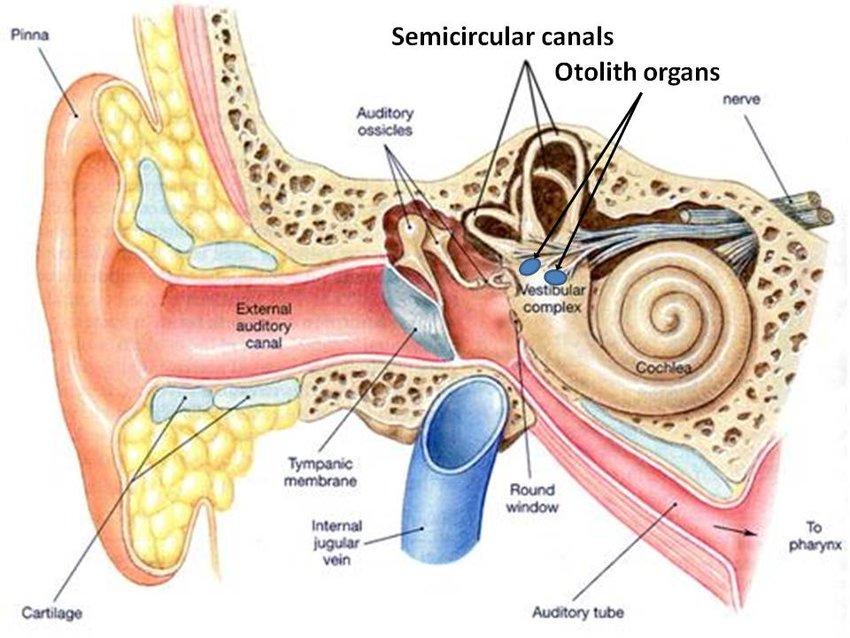
In the inner ear, there is a three loop-shaped structure (semicircular canals), containing fluid and fine, hair-like sensors that monitor the head rotation (up and down, right and left, back and forth). Other inner ear structures (otolith organs) containing calcium crystals, stimulate the vestibular nerve to send signals to the brain about head and body movements in relation to gravity.
Normally, these calcium crystals are static and adherent to the otolith organs. However, when they become dislodged, and move into one of the semicircular canals, it causes the canal to become sensitive to head position changes that it’s not used to. As a result, one will feel dizzy.
Symptoms
- Spinning or dizziness
- Loss of balance of unsteadiness
- Nausea
- Vomiting
- Sweating
- Abnormal or jerking eye movements (nystagmus)
- Ringing in the ears (tinnitus)
These symptoms are usually provoked by head motion, looking up or down. The spinning sensation is usually violent but brief, lasting less than one minute.
Treatment
Treatment for vertigo depends on the underlying cause. Usually it resolves on its own within a few weeks or months. For some, treatment may be needed, such as:
- VESTIBULAR REHABILITATION TRAINING (VRT). This is a form of “brain retraining” program involving exercises that encourage the brain to adapt to the abnormal messages sent from the ears.
- CANALITH REPOSITIONING MANEUVERS. This procedure consists of several simple manoeuvres for head positioning. The aim is to move the calcium deposits out the fluid filled semicircular canals into the vestibule that houses one of the otolith organs (utricle) in your ear. Once there, these particles won't cause vertigo and are likely to dissolve or be reabsorbed by bodily fluids in the ear.
- MEDICINE. The common prescribed medications are prochlorperazine and some antihistamines.
- SURGERY. The doctor may recommend a surgical procedure in which a bone plug is inserted into the inner ear to block the area where vertigo is triggered. This plug prevents the ear from responding to particle movements inside the semicircular canal of the inner ear that may lead to vertigo.
Do's and Don'ts
Do’s
- Lie still in a quiet and dark room to reduce the spinning feeling.
- Switch on the lights if you get up at night.
- Make adaptations at home to prevent falls. Walk with a cane for stability if you are prone of failing.
- Sit down as soon as you feel dizzy.
- Sleep with the head slightly raised; at least 2 pillows.
- Get up slowly from bed and sit on the edge of the bed for a few minutes before standing.
- Take care when looking upward
Don’ts
- Do not bend over to pick things up. Instead, squat to lower yourself.
- Do not make sudden changes in head position.
- Do not drive or operate heavy machinery when having episodes of vertigo.
Talk to your doctor today if your vertigo recurs or don’t won’t go away.
References:
- Vertigo | MedBroadcast
- Benign Paroxysmal Positional Vertigo (BPPV) | Mayo Clinic
- Vertigo | NHS Inform
Image credit:
- https://bit.ly/2EYFQl8
- https://bloximages.newyork1.vip.townnews.com/agrinews-pubs.com/content/tncms/assets/v3/editorial/8/94/89458afb-1d29-5e6c-bbc4-921c4c84de81/5caf4c0d540cd.image.jpg?resize=1200%2C797
- https://i.pinimg.com/originals/b8/4e/81/b84e81ff7858c12a577cdf41574b5cd9.jpg